

The AI Moment: Promise vs. Reality
Last year in November 2024, I saw Des Traynor of Intercom on stage at SaaStock make a prediction. By the end of April 2025 (around about now), people will begin to climb out of the "trough of disillusionment," following the initial AI frenzy kicked off by ChatGPT over the past couple of years.
Des was right.
Looking back on my own experience, the hype was real in 2024, including a tonne of real-world business AI experiments and POCs across all industries.
In 2025, AI vendors and consultants are pushing hard on an AI-first agenda. Your LinkedIn feed is now flooded with AI FOMO (*fear of missing out), but right now it looks like it will still take a while for AI to really become mainstream at an industrial, enterprise level.
Why?
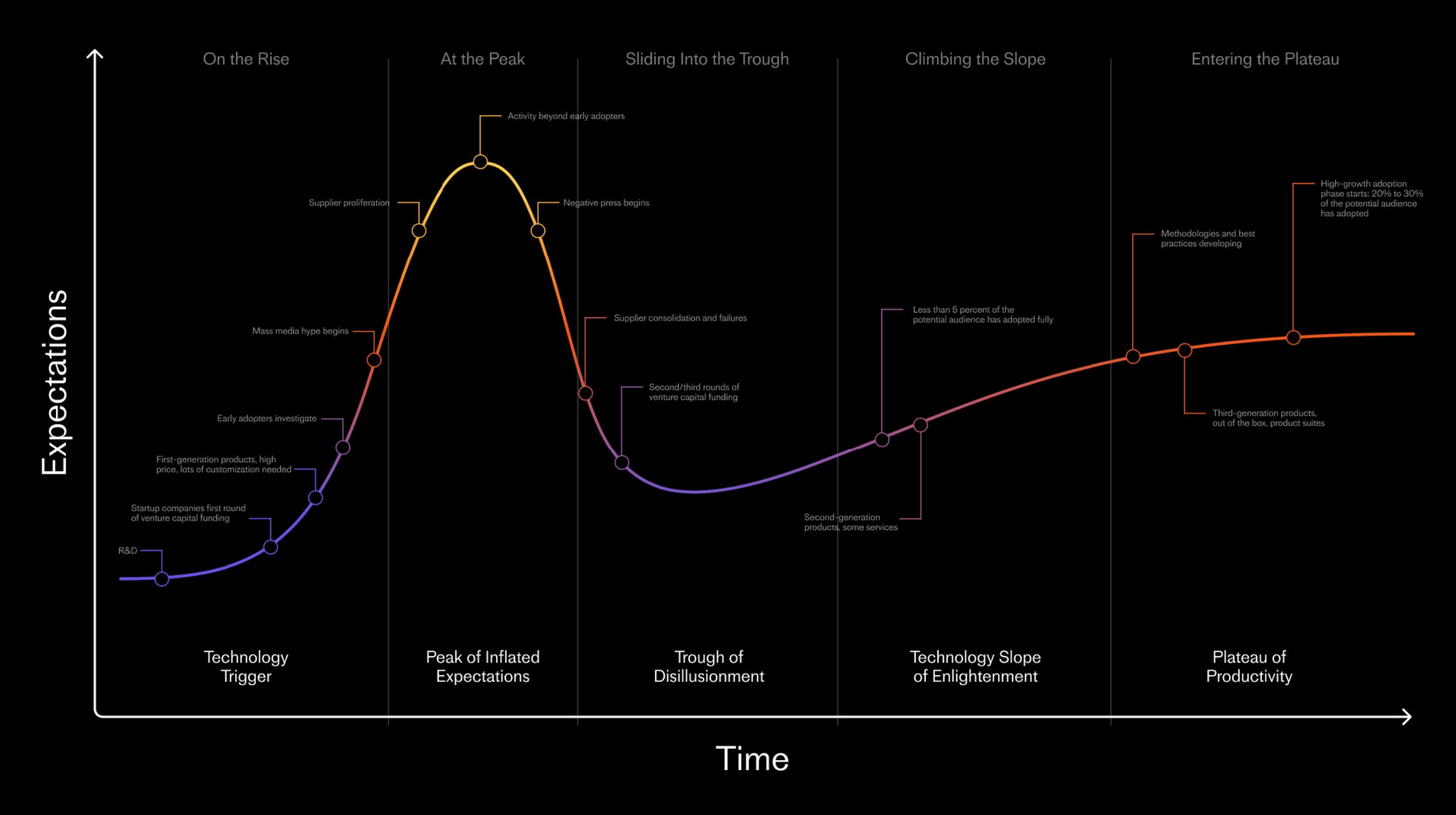
Businesses in general have yet to 'cross the chasm' of skepticism and fear associated with any new technology in the 'hype cycle'.
The Trailblazers
First movers, many of them AI and tech startups themselves, are certainly accelerating into AI and showing what can be done. They’re absorbing the risk and getting extraordinary results by plugging in AI early to see what happens. The larger incumbents who might have more to lose are still wary.
A lot of people I’ve spoken to over the last year, in Europe in particular, are taking a more ‘wait and see’ attitude to AI, despite sometimes having direct mandates from their C-Suite to use AI anywhere they can.
The Hesitants
Company buyers explore AI platforms with enthusiasm before they often get stuck in the "implementation gap" – the space between the promise of AI and the reality of making it work in their actual business.
The Hesitants want to know more about what’ll happen before they let AI have real conversations with actual customers. They are anxious about giving AI the ability to act and leverage on their internal systems, where AI might actually break something important in customer relationships. They want to know what it’ll cost, really, once they let AI loose.
According to a survey by Slalom Consulting, while a significant 79% of businesses are running AI pilot initiatives and 68% have already seen productivity gains, a smaller 31% are beginning to leverage AI for differentiation and disruption through more advanced applications.
This reveals a critical disconnect between financial commitment and strategic execution.
So what's going on? Why is AI implementation getting stuck?
Understanding AI Memory & Context
"Think of AI as having two kinds of memory: long-term memory and short-term memory.
AI's long-term memory is basically what's called training data. These days all the major AI models have the same training data, more or less. The entire internet is AI's long term memory.
Most of the advantage of working with AI now comes from short-term memory; the specifics of the problem you're trying to solve, which we call your context. The context is what you supply to the AI for it to know something about you."
Tiago Forte
Short-term AI memory is the data that your AI is working with in any particular moment. AI will ask 'What is the conversation I'm having right now?' and use short-term memory to orientate itself before reaching into long-term memory for answers.
Context is very important to consider when you start using AI.
YOU set the context for YOUR AI.
But since context is quite subjective and can be hard to pin down, both technically and conceptually, it’s also a sticking point for those wishing to embark on their first steps with AI.
The 3 Dimensions of Context
Customer Context: Your deep understanding of customer struggles in specific situations
Operational Context: Your unique processes, workflows, and organisational knowledge
Market Context: Your distinctive position relative to competitors and industry trends
Setting the context for your unique use of AI forms the gap between buying AI and implementing AI. As the use of AI grows more common, the real edge for business use cases is in applying your unique knowledge and USP to any context.
But while most organisations understand AI's potential, they're failing to recognise that their unique context is the primary differentiator in success.
The first step in launching any AI initiative is defining the context for your own unique use of AI.
To understand why this is so critical, we need to look more closely at the implementation gap that's emerging.
The Gap
I launched a new AI services business with a co-founder in 2024 called Journey Mapper, partnering early with Intercom to focus on AI for Customer Service.
What we’ve seen is that sophisticated AI stacks often fail to deliver because of internal complexity and inertia.
We actually saw less action coming from those companies that claimed more sophistication in CX and customer support.
I've been involved in selling GenAI applications since 2016, when I was first exposed to AI models and PhD level AI scientists as a Marketing Director at Boxever, a travel focused 'CDP' that was later acquired by Sitecore. I've also worked with a couple more well-funded AI startups since. When it comes to the practical use of AI, I'd say I'm beyond a novice, but nowhere near as good as a Doctor of Artificial Intelligence from MIT. Somewhere in the middle.
In the early days, selling AI in real life was more like R&D. Most businesses weren't ready.
But some things remain familiar.
The gap between what an organisation wants from a new technology like AI and the very real struggles people in charge of that investment have when they think about how it’ll impact them is pretty big.
As it should be - AI will change all of our daily routines, it will impact in fundamental ways our ways of managing people and systems, and ultimately it will alter the economic realities of work and value.
People need to take a minute.
Investing in your AI platform
When you buy into an agnostic (meaning it’ll work anywhere) AI Agent like Intercom's FIN, or a platform native solution like Agentforce, or HubSpot's Customer Agent powered by Breeze AI, each will promise 50-90% resolution rates right out of the box.
But what does that mean exactly?
The sales pitch makes AI sound seamless: Connect your knowledge base, set up a few workflows, and watch the magic happen…
But here's what actually happens: Your AI is immediately confronted with your messy business reality – fragmented knowledge bases, undefined processes, and brand guidelines that were never designed for conversational AI.
For your AI to reach beyond 50% resolution rates in Customer Support, for example, significant and continuous honing and crafting is necessary.
For now at least, humans still have to conduct the AI orchestra for it to sound good.
AI Vendors are telling the truth about their AI
Let’s be clear -
The best AI Vendors aren't lying about their capabilities.
AI really can do more than you think. When you first turn on AI in your organisation it's the worst it'll ever be, and AI is awesome already. It is only going to get better, and AI itself is going to make AI it easier and easier.
[note: If you still don’t believe in AI’s capabilities and have yet to move beyond trying ChatGPT to do basic tasks, try putting some skin in the game and pay $200 for ChatGPT Advanced or Claude MAX for just one month. Get it to do just one bit of research, or just one part of your typical daily process. Then let me know how you got on.]
The question we’ve been arguing about for 12 months is: how does a buyer even know the difference between a GPT hack and something like FIN, which is built with years of R&D? The skepticism is real.
In practice, getting the most out of AI today still requires significant expertise, commitment, time, and organisational change. As you'd expect of any technology transformation.
McKinsey’s 2025 State of AI Survey reports that 83% of organisations cite “data fragmentation” as the primary barrier to AI scaling, with only 15% achieving enterprise-wide integration.
Technology should be easy, but it ain’t, mostly
For comparison, let’s briefly talk about CRMs, based on my own exposure to implementing them for clients as someone running a HubSpot Platinum Tier Solutions Partner agency, Mount Arbor for almost a decade.
I've spent 8 years selling CRMs to people who hate CRMs.
When someone invests in a CRM platform they are often under the impression often that their CRM will just work on its own. This is an impossible dream designed by vendors to close deals and attract customers. Nobody really believes it, but still - people are often annoyed they need to talk to me about their CRM in the first place. I try not to take it personally.
See, with a CRM, to get the whole thing to work it’s usually not the technology that’s lacking - it’s the extraordinary complexity of your customers that throws all the standard processes out of whack so you have to customise almost everything.
I call it the ‘Pesky Human Problem’.
“It’s not that AI technology isn’t up to the challenge. We just haven’t supported it with the right enablers—both technological and human.” - Deloitte Insights article.
Most engineers would love the pesky human problem to go away, but business owners understand that their customers need more than the fastest path to an outcome in order to be satisfied.
What if it’s the wrong outcome?
What if your customer doesn’t even know what they want in the first place?
The challenge with CRMs (and Customer Experience in general) is that most customers don’t know what they want. Not really.
Expecting customers to know what they want causes everyone to design and build the wrong systems.
Humans are more complicated than that, so the way you use your technology in the customer experience also becomes a bit tricky.
It’s a similar pattern with AI investment.
“It’s not the customer’s job to know what they want” - Steve Jobs
Real-World AI Struggles
Let me share some real-world examples of companies struggling with AI:
Customer Support AI Reality: One company connected their knowledge base to a leading AI platform expecting exceptional resolution rates above 50%. Months later they were still at 30%. It wasn't the AI – it was their fragmented, outdated knowledge base that lacked conversational context. But they blamed AI and decided to pause their AI program for a while.
Internal Policy Assistant Goes By the Book: An Enterprise AI pilot designed to answer employee questions went unused. Despite having access to all documentation, it couldn't handle the unwritten exceptions and departmental variations. As one employee put it: "It just gives me the handbook answer I already know isn't right."
Marketing Chatbot Failure: A SaaS company's technically perfect website chatbot caused conversion rates to drop. All the marketing team's carefully crafted messaging never made it into the AI's knowledge base, so the bot sounded like a bot and was largely ignored, despite the advanced technology running it.
In a year or two, people will look at this list and laugh at how stupid it is.
All of these bottlenecks can be fixed, but when people hear stories like this early in the hype cycle, it can fuel skepticism and inertia.
What do you think is the number one concern I've heard from most people when we talk about conversational AI?
It's not whether the AI will technically work, or even if it's secure and safe.
It's the control of brand and tone of voice.
While these issues seem technical, they actually reveal a fundamental misunderstanding about how AI adoption works.
Resistance Among Those Who Benefit Most
At Journey Mapper over the past year or so, we’ve been helping clients to implement AI solutions for better Customer Experience (CX).
Since early 2024, we’ve been talking with Customer Support and Customer Success (CS) leaders at leading mid-market SaaS companies across Europe. We’ve been spending a lot of time with CX leaders who want to learn more about the promise of transformation and efficiency in AI.
We ran a series of successful webinars during the year that covered a lot of ground.
We spoke to hundreds of the people who stood to gain or lose the most with pioneering deployments of AI in Customer Support.
What we discovered shouldn’t come as a surprise.
A lot of them aren’t that keen on AI. Not yet.
Customer Support leaders are historically among the most change-resistant in the enterprise.
CS leaders are evaluated on consistency, reliability, and satisfaction scores. Their primary incentive is stability, not transformation.
Asking CX Leaders in particular to undertake radical platform changes, where most haven't changed platform for 20 or 30 years, represents a substantial risk with uncertain rewards.
Take Intercom’s FIN AI Agent, for example.
Technically, it's hard to understand why everyone wouldn't just add FIN to their existing platform (e.g. Zendesk or Salesforce), just to see if it works. A lot of people do - FIN is an industry leading, fast growing product that will blow your mind and very exciting for those who try it out.
But this isn't a technical struggle. It's an emotional and social one.
A lot of CX Leaders are taking baby steps, and taking a 'wait and see' approach.
Wouldn't you, if it was your job?
When I sold HubSpot services, I was usually dealing with customers who had used their CRM for a year or two. They already know how complex it is and that they need help.
We’re still in the very early days of AI.
We're asking leaders to take a leap of faith on AI technology that's still evolving.
Despite compelling evidence showing AI's positive impact on efficiency, quality and customer experience, there are a lot of potential pitfalls to be considered too.
The AI Adoption Journey
“A quarter of CIOs have launched something - but half don’t plan anything for at least a year” - Benedict Evans, AI Eats The World presentation, 2025, slide 59.
Working with dozens of organisations implementing AI, I've observed the adoption journey typically follows three distinct phases:
1. Initial Implementation: Setting up the foundational knowledge base, configuring the first workflows and conversation flows, and setting the initial parameters for brand and tone of voice.
2. Optimisation Phase: Refining AI behaviour, content, and actions based on performance data and feedback loops, adding more external data to enrich the experience.
3. Strategic Integration: Elevating AI from a support tool to a strategic business advantage, by applying unique and inventive uses of AI to enhance the customer experience.
AI vendors sell the vision of phase three (Strategic Integration), but so far most customers can barely get through phase one (Initial Implementation) without help.
The Skills Gap in an AI-Powered Economy
Successful AI implementation requires a unique blend of skills that doesn't neatly fit into existing organisational roles. This is what the AI vendors mean when they say that AI won't put people out of work, it'll simply require people to get skilled up in other areas.
Based on my experience so far, the key capabilities now in demand include:
Conversational AI Implementation & Optimisation
Customer Journey Design & Enhancement
Cross-Functional Collaboration (CX, Product, Marketing)
Performance Analytics & Data-Driven Improvements
Content Strategy & Workflow Optimisation
AI-Powered Automation Strategy
Brand Voice & Tone Alignment
These skills aren't typically found in a single individual or even within a single department.
Traditional customer support teams excel at understanding customer issues but may lack the technical skills to optimise AI systems. Marketing teams understand brand voice but may not grasp the nuances of conversation design for support contexts. Engineering teams can integrate systems but may not understand the human elements of customer experience.
This skills gap represents both a challenge and an opportunity, but requires co-operation, training and experimentation in finding new ways to work alongside AI.
These challenges point to a fundamental gap that needs addressing.
I propose a framework for solving what I call the "AI Context Activation Gap."
The AI Context Activation Framework
“Take a stakeholder from every department, build an AI board, and start pointing at horizontal solutions. Then you’ll actually get value.” - Jonny Marriott, Glean.ai, speaking on a Journey Mapper webinar in 2024
The 'AI Context Activation Gap' is a failure to adequately leverage unique organisational context. Activating Context is about the specific nuances of your business, your customers, your internal processes, and even your unwritten rules and cultural understanding.
For example, even within business communication, the challenge lies in humans constantly moving context between silos like email, Slack, and even tools like HubSpot and Figma. Without explicitly feeding this crucial business context into your AI initiatives, you're essentially asking a powerful tool to operate blindfolded.
The growing demand for roles like AI managers and knowledge managers is external validation of the importance of managing and leveraging organisational context. Companies who use their unique knowledge to activate their USP across their own context window for AI in a deliberate, planned way are going to do better than companies just buying AI tools and hoping for the best.
AI's general knowledge is becoming less and less special. The three dimensions of a company's unique context is becoming the key differentiator for companies committed to an 'AI-first' advantage.
Onboard your newly hired AI like a human
"We think about it just like that new hire. They’ve just landed in seat for the first time. First, we train them up on all the knowledge… then it’s about tone, behavior, and how they interact with customers." — Paul Maher, GTM at Intercom speaking on a webinar hosted by Journey Mapper
One simple rule of thumb to guide the onboarding of AI in your organisation is to treat it as you would the onboarding of a new employee, rather than a technology transformation project.
Once you start to think of 'hiring AI' this way, you begin to see how your existing onboarding programs, management systems and knowledge bases can be used to onboard your AI more effectively than a technical migration program would.
Consider AI Agents to be a new hire, with all the same challenges any new hire would face when starting a new job with a new team, talking to new customers about a new product. Except AI's onboarding ramp time is usually weeks, not months, and it doesn't forget anything.
You'll also see how culturally, an AI Agent almost needs to be treated similar to how you'd onboard a human when it comes to setting the boundaries of value-based decisions and behaviour.
Remember, AI Platforms are incentivised to present their solutions as easy to implement to drive adoption, but this can create unrealistic expectations that ultimately harm long-term success.
A Way Forward: Bridging the AI Context Activation Gap
AI is fully onboarded once your unique AI Context has been Activated and deployed to customers. I see several potential paths forward for addressing the AI Context Activation gap.
For AI Platform Vendors:
Reconsider your market category: Rather than positioning as replacements for established platforms, consider whether adjacent categories might offer better alignment with current capabilities.
Invest more heavily in Activation services: Whether through internal teams or partner programs, recognise that successful AI Activation and Context Management require specialised expertise.
Be more realistic about implementation requirements: Setting appropriate expectations about the expertise and effort required will lead to more successful deployments.
For Solutions Partners:
Develop specialised, vertical-specific offerings: Rather than generic implementation services, create packages tailored to specific industries or use cases.
Build proprietary methodologies: Differentiate through unique approaches to implementation rather than just platform expertise.
Consider alternative business models: Explore outcome-based pricing or recurring service models that better align with customer value realisation.
For Enterprises Adopting AI:
Recognise the expertise gap: Be realistic about internal capabilities and the expertise required for successful implementation.
Start with focused use cases: Rather than attempting wholesale replacement of existing systems, identify specific, high-value use cases for initial implementation.
Invest in internal capability building: Alongside external expertise, develop internal teams that can own and evolve AI systems over time.
Your AI Path Requires Contextual Honesty
AI technology is powerful and transformative, but we're still figuring out how to implement it effectively.
How each business embraces AI in its own organisation requires honesty about the challenges and a willingness to adapt their approach to the unique and sometimes counter-intuitive signals of their customer.
The irony is that the more powerful AI becomes, the more hesitant and anxious people get about just 'plugging it in'.
The slower a business is to start, the less likely a business is to be able to ‘corner it’s context’.
What’s uniquely yours today may not be tomorrow, unless you grasp it now.
Start using AI now in order with a goal to own, manage and deploy your unique contextual knowledge.
Close your AI Context Activation gap as soon as possible so the 'tacit knowledge' inherent in your organisation quickly gets passed into the 'short term' memory of your company's own Context Window.
Protect your UNIQUENESS above all else in order to remain competitive in an increasingly ambiguous economy.
For my part, I remain excited about the potential of AI in customer experience despite the implementation challenges and the disruption it’ll cause.
As AI platforms and tools continue to evolve rapidly, and each implementation gets a bit easier than the last.
Realising the full potential of AI in your organisation will require more than just better technology - it will require new skills, new business models, and new ways of thinking about implementation and partnership.
The companies that recognise this reality and adapt accordingly will be the ones that successfully bridge the AI Context Activation gap.
Andrew McAvinchey is a certified Intercom FIN AI implementation specialist and co-founder of Journey Mapper, a consultancy focused on customer experience transformation through AI and technology. With over 15 years of experience in technology and customer experience, he has worked with organisations across industries to implement and optimise customer-facing technologies.