

Unlimited resources for processing anything previously invented is still a brain leap too far for most of us to make. Me included. My head melts when I think about it. AI promises the world of what we know, but what then?
What does running a business mean if most of the WORK is done before we get to the office?
Automation by AI of everything ‘automatable’ is entirely possible.
Creation of new things by AI is debatable, but still possible.
In my work with creative business owners exploring genAI over the past couple of years, what stands out is just how disruptive AI actually is to existing business models and processes.
I've noticed from several deployments of AI in enterprise businesses that even while good AI use scales marketing, sales and operations beyond anything previously imaginable, there's a pesky human problem acting as a Gremlin in the wires.

The problem with most humans is that they don't really know what they want.
And they definitely struggle with expressing it.
If you ask AI what your customer said they wanted, AI will tell you exactly what they said. Advanced AI with NLP for voice analysis might even allow you to pick up on the nuances of what they might have meant.
Where AI will struggle, just like we all do, is knowing what people really want.
What are they lying about?
Where are they unaware of the causes of their struggle?
Why now? Why is it important to solve their struggle today?
Businesses are there to help people with specific struggles, and they’re hired to remove that struggle so the customer can make progress. That’s pretty much it. Everything else is extra - it’s good extra, but it’s still extra.
The more vague those customer struggles are, the more costly it can be to scale the wrong systems and processes with AI.
Telling AI to “just go ramp up the system” results in a Frankenstein's monster of overlapping, siloed, supply side junk, while the essential elements remain hidden and sub-optimal for every customer.
Scaling the wrong things has always been a problem in business, it's just getting much bigger.
I’ve come across the problem of scaling the wrong insights over the years on a minor scale, before AI came along to magnify everything exponentially.
I helped businesses to scale systems and processes in different capacities and layers and roles - from Marketing down to Ops, it was always clear that essential elements that helped grow the business were usually simpler and cheaper than the costly noise of systems, people and status quo thinking that was surrounding them.
Over the last two years, I’ve used AI creatively to identify and scale the right insights to achieve the following outcomes:
one business owner deployed a genAI sales pipeline and lead handling system that resulted in a GBP2.5 million exit (6 month project)
one business owner applied a gap analysis I compiled followed by a systematic dismantling and restructuring of ‘supply side’ people, processes and communications to add 40% revenue YoY, adding 7.5 million in additional revenue over the next 3 years (3 month project)
another business owner repositioned around customer insights that showed that clients were lying about what they really hired for - resulting in an 80% cut in content and marketing costs, and accelerated growth (6 week project)
The businesses growing exponentially fast with AI are those who are most specific, deliberate and streamlined about what their customers want.
We're only beginning to see how SaaS, Service and other business models are being systematically dismantled by AI. It's still early days. Everything changes when the work changes.
One of the best funded, most flexible and focused 'startups' in AI is Intercom, or more specifically, FIN.ai.
As a certified partner and onboarding specialist for Intercom’s advanced AI technology, I got exposed very early to what is emerging as the fastest growing and best positioned AI agent platform in the market.
I’m also certified in Salesforce’s Agentforce technology, HubSpot’s Breeze AI (where I’m a Gold Solutions Partner) and other independent platforms like Make.com, bubble and integrated solutions in Airtable/Notion.
Last year I started a business with a co-founder to partner with Intercom as an implementation partner for its nascent AI platform, which back then was just a component of the existing Helpdesk platform they offered to customers.
Our bet was that just like every other SaaS company we’d ever encountered, they’d inevitably need partner support to capture the overflow for rising demand as they grew and struggled with deployment, onboarding, customisation and so on.
This was a bad bet. Not a terrible one. But like many businesses floundering in the face of AI and the associated business model disruption it brings, it challenged us to think very deeply about value.
Cookie cutter businesses do not survive in the face of AI.
In our case, we struggled to find a gap for professional services in deploying AI when FIN was sold as a simple plug in solution that got up to speed pretty quickly on its own.
As a partner, we were also competing with Intercom’s own professional services team, who were fully optimised for 10x productivity with AI.
Last week, Intercom announced a $1 million guarantee for anyone buying Fin.ai.
This is exciting and devastating in equal measure.
As an Intercom solutions partner, this is what that sounds like to me:
Fin.ai will work. If it doesn’t we’ll give you $1 million
If after you have either made FIN.ai work yourself, or worked with our internal team to make it work, OR refused a million dollars when it doesn’t… then you might want to work with a solutions partner, who can help.
The partner model just got chucked out the window with the old photocopier.
Bye bye.
So what do we do now?
Well, luckily we were flexible enough to adapt, and saw the writing on the wall around about December last year when I stepped out and my co-founder carried on.
Right now, my co-founder is dismantling the new new new business landscape, and continuing to run the business we began as a successful and valuable partner to anyone using Fin.ai.
I’m focused on consultancy projects, working on building out successful case studies with AI, and working with diverse partners and platforms to deliver value anywhere I can.
I’ve learned a lot on this journey over the past year and I thought it would be worth sharing.
It's telling that Intercom recently split out FIN.ai as a separate thing, and chose to focus on:
Knowledge
Behaviour
Insights
Action
What this means is that FIN.ai is finding product/market fit somewhere other than where Intercom originally positioned it.
AI is bigger than we might have thought, and it’s got very little to do with help desk technology.
Customer Support is just an entry point and the most valuable, logical sandbox for establishing new business models and astronomical growth for an ambitious startup.
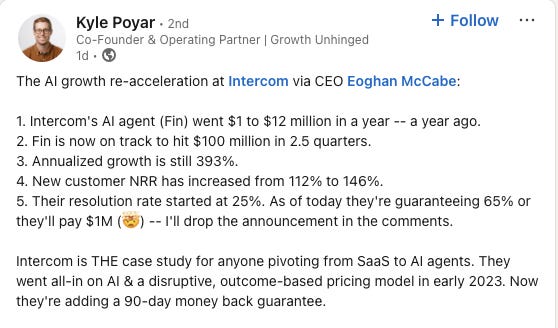
See link: AI growth re-acceleration at Intercom
If Intercom are leading the race to enterprise deployment of AI across the world, have the world’s leading AI agent, and are prioritising not just AI but the surrounding management layer around the use of AI… shouldn’t that tell us something about the importance of creative nuance and understanding in business?
If you look at the layers of abstraction between AI just doing what it does, and the creative management of that genAI processing and layered threads of AI deployment, you begin to see the pesky human problem cropping up in each of the 4 layers being developed at Intercom.
This layering is also embedded in the evolving AI platforms in use at Glean.ai, Agentforce/Salesforce, HubSpot/Breeze AI and independent AI stacks.
It helps to break apart the layers to search for the human, creative core:
Knowledge: all knowledge that ever existed is (or will be) available to AI, as long as it’s been published at some point. However, as we discussed earlier, discovering what people want is almost imperceptible sometimes. It certainly doesn’t live in most CRMs or Google Docs folders. What people want isn’t in most datasets, and never was. We’re guessing what people want most of the time, so we use intuition, guesses and good strategic management to compensate. If you ask a customer what they want, they’ll tell you what they think they want, and most definitely won’t tell you what they actually need. That’s where good business leaders make choices. Strategic decisions have no right or wrong answers… that’s hard for AI to comprehend.
Behaviour: people behave great in a good system. Most systems are bad systems. People hate bad systems. AI doesn’t care. Yet bad systems scaled by AI, or even made more efficient by AI, are unimaginably costly. People’s behaviour is tricky. People can be weird. Weird costs a lot in a scaled system. If you’re anything other than an established, incumbent business with everything locked down, it’s even worse. Good business leaders compensate for behaviour of their customers by adapting to obvious human signals and behaviour that may not be so obvious to AI.
Action: the idea that a business is a machine makes a lot of sense. It’s especially appealing to engineers. If this, then do that. But engineers will often ‘build the product right, but not the right product’. Agentic systems designed to take independent action works as long as the actions taken fit the bill. Actions based on insights performed by agents are probably the safest area for scaling existing processes. Most businesses will have a general idea of their repeatable processes. By then the problems the business solves have probably been framed correctly. But not always. Passing Knowledge and Behaviour through the filters of common sense usually leads to the correct action. So AI agents are probably in safe territory here. But safe isn’t that creative… what else could we do?
Insights: Insights are not data. AI will guess at what’s most important for you to know in order for you, or an adjacent AI agent, to decide what to do with the newest available dataset. Great! In the future, we’ll learn a lot from this unprecedented knowledge and understanding of what exists in our business. At the core human level, we’ll learn very little new, or exciting. Without curiosity, ingenuity or desire, insights can come out as more noise and more productivity measures. Once the noise and productivity has been taken care of, what insights will lead to more creativity in business? What insights will inspire?
Most debate around AI occurs at the process or people level - can or will AI replace humans in systems, processes and experiences. Where will that happen and when?
The artists are always the ones to watch when it comes to revolution. Whenever I'm lost, I turn to art.
I'm a bit lost right now, so art is helping me make sense of it all.
In this piece by a working artist in the NYT, Christopher Niemann shares in the most beautiful, creative and visual way his own experience of AI and the implications for his own creativity as an artist.
If AI allows creative business leaders to create anything that has ever been created easily and quickly...
What do you want to create next?