The balance between standardisation and uniqueness is like a seesaw, with the heavy weight of standards on one side and the dense, valuable uniqueness of you on the other.
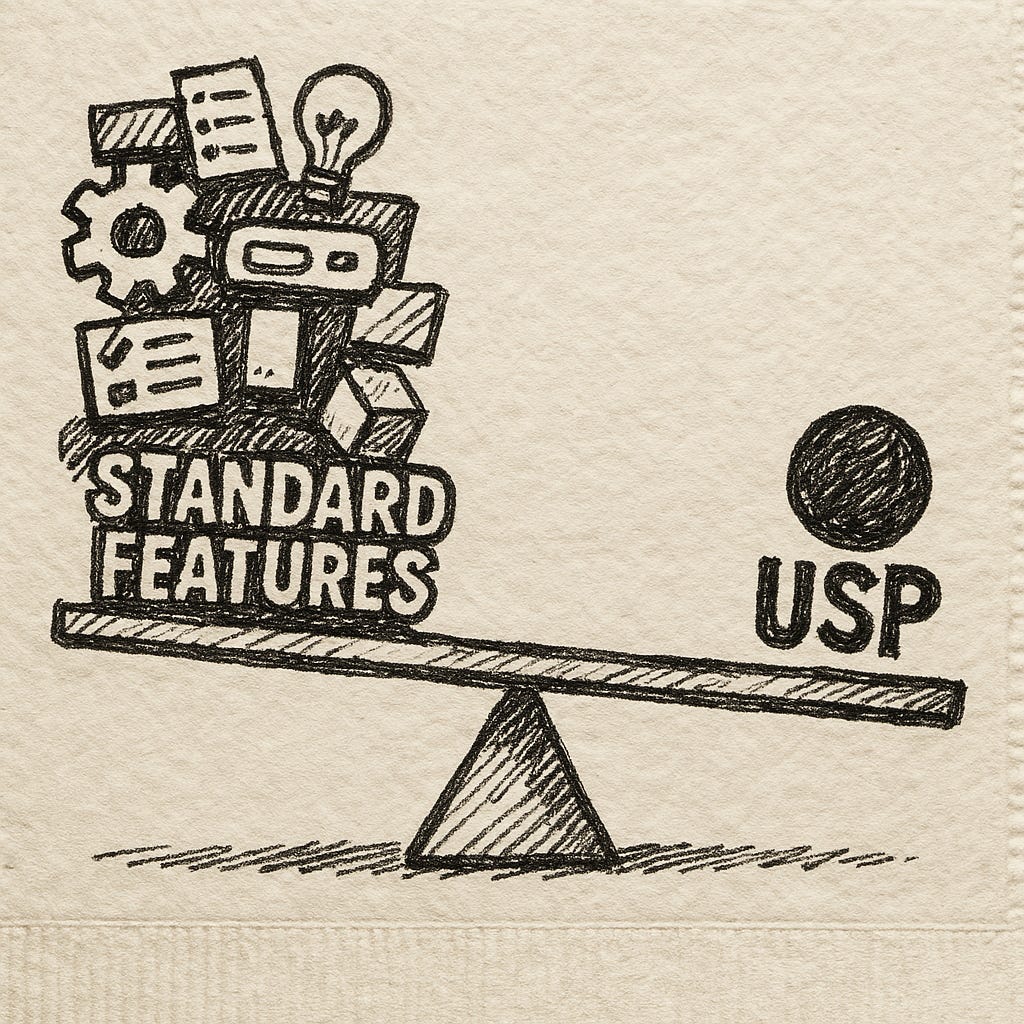
When a purchase is being considered, the decision to buy is based on a weighing up of all the options against each other, including the unique aspects which serve as a counter-weight to the standard.
Being Unique in order to sell things and make money
In business, a USP (Unique Selling Proposition) is the way companies define their difference in a digestible way for buyers. USP helps people to decide to buy one product over another. In employment, a person’s ‘USP’ could be considered the deciding factor on whether to hire one person over another.
Your Unique Selling Proposition is an acceptable way to present your difference in the context of the standard. It’s a way to politely suggest that you’re safe and reliable and familiar, but with an edge.
Your USP is a sprinkle of difference that says you’re going to do what’s expected, and then go beyond in a meaningful way. The further beyond you go, the more valuable your USP.
There are certain prerequisites for establishing your USP. Among them are making sure to show comparable solutions, reasons you’re different, and when or where you’re generally useful.
Being unique on its own isn’t enough. You’ve got to be unique in comparison to something else.
A unicorn is unique, just like aspects of a person, product, or company are considered unique because among all other things, nothing like it can be found in the whole wide world.
If we weren’t sure that nothing else like a unicorn exists, then we wouldn’t know it was unique, would we?
Uniqueness is a relative state.
Let’s take socks as an example.
If I’m shopping for a pair of socks, they’re all pretty much the same… except this pair, oh this pair, their lined with water resistant plush felt and toe hugging patented heat technology, so, you know, these are the socks for me…
Meeting the standard, then exceeding it with a dash of the unfamiliar, has always been important in establishing value. Commodities can be bought from suppliers in bulk, and suppliers can be swapped in and out of a supply chain, because a USP has less value in a commodities market.
Price is often the biggest factor in buyers’ decision making process when it comes to buying the same thing from one supplier over another.
You don’t really need a USP in a commodities market, other than price and a few other variables. I’m not going to go into commodities markets, because they’re so boring and I know very little about them. For now, let’s assume you don’t want to be a commodity.
Why you need a USP, even if your thing is pretty standard
If you’re selling services, premium products, technology or anything else that requires you to establish a value considered by your buyer as beyond the standard, then you need a USP.
In the technology or software market, for example, companies sell more based on how they compare to their competitors.
If a software product differs enough from the next best option, and exceeds the standard expectation as a result, they can charge more for the additional value that particular difference brings.
Your USP describes this difference in ways that make sense to someone ready to buy.
Being different is important in a market where buyers consider more than price when they choose a supplier.
AI MAKES YOUR USP DYNAMIC AND IT CHANGES ACCORDING TO THE CONTEXT
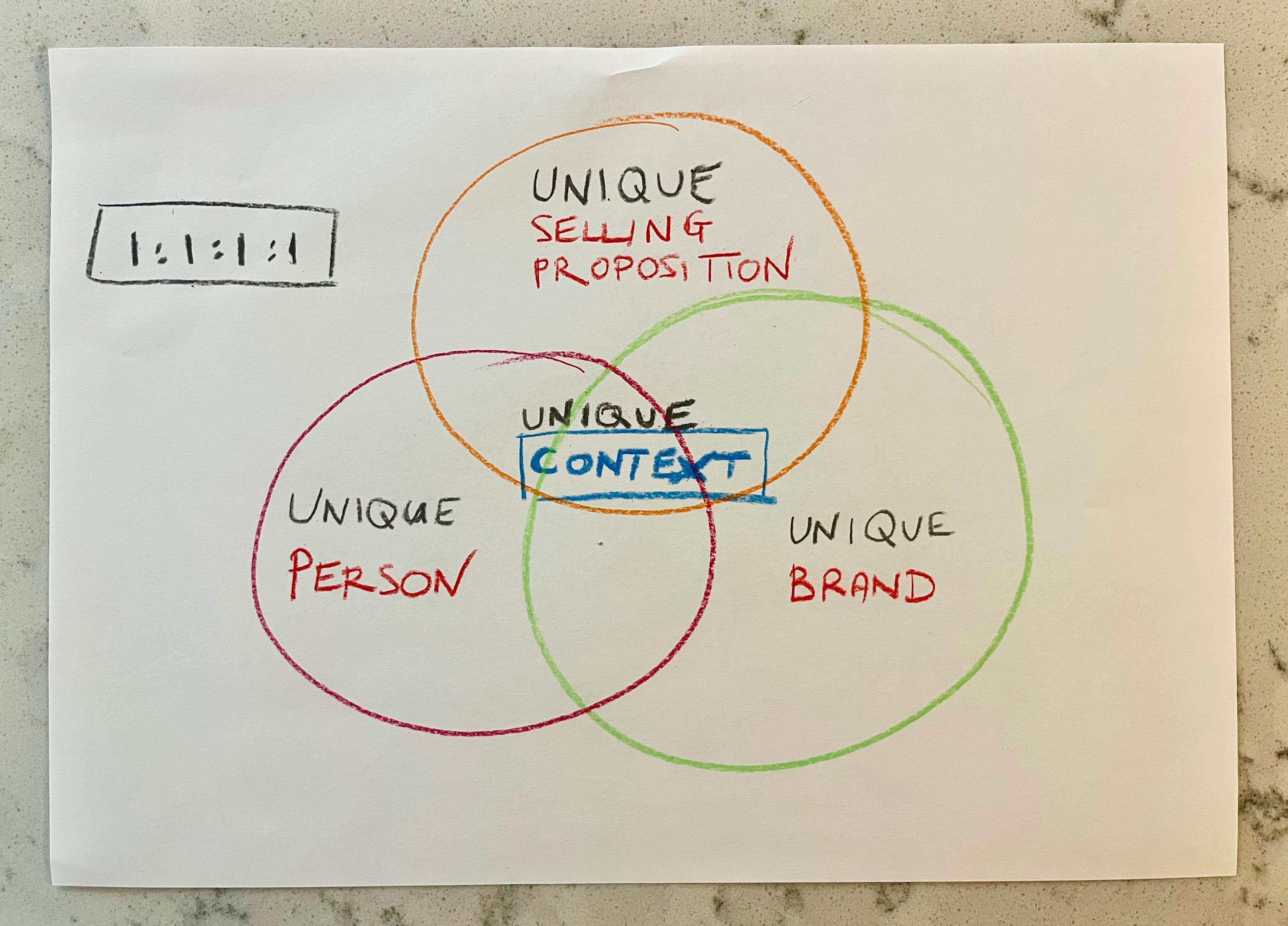
When A.I. is responsible for your Customer Experience, what the customer experiences at any moment will depend on the person affected, the brand delivering value, and the USP which are all dependent on the context.
When A.I. can dynamically represent your brand and offer customers exactly what they need in their ‘struggling moment’, the USP, the brand are actually variables (not fixed) which can change dynamically depending on the person interacting with the A.I., how much you know about them, and the context.
A.I. makes everything fluid, even the things that were fixed before like your brand and your USP.
What is context?
The context is the space, time and circumstances of any one exchange of value involving any one person at any one time.
Being unique is invaluable when the context is known and understood.
We usually pay more for products, services or employees who meet the standard but exceed what we’d expect from the average.
If we can clearly show how we are unique, not just different, then we can usually charge more if we want because we’ve established that our thing is rare and thus price it accordingly.
A.I. makes it possible for systems and people to be presented with a unique assembly of a dynamically assigned ‘Unique Selling Proposition’ based on the timing of any interaction with a known customer. Your USP can remain the same for every person, but it can also be different for each. Up to you.
This complicates matters when your USP is set in stone.
It opens up the possibility that you can set the criteria for your USP to be dynamically created according to your own unique ideas of what you’d present to a customer or a person if they were in a particular situation, dealing with a particular struggle, at any particular time.
The whole customer experience can rotate around the customer, dynamically changing in real time to provide a customised, unique experience dependent on the moment, the person, and what progress they’re trying to make.
Can you imagine?
Pricing will be dynamic too.
Price is a variable under the control of the supplier, and it can be used in strategic ways to position a USP more competitively in the market.
For the last 20 years or so cloud software companies (SaaS) have often charged less than their competitors for their USPs to gain an unfair advantage in their market.
SaaS companies can distribute their costs of delivery across their customer base over time, in order to offer something revolutionary. They can be disruptive very quickly in a large market of buyers by applying an ‘economy of scale’ to their products and services.
Salesforce can offer billions of dollars of software to any individual for 49 bucks a month. That’s been the theory up to now anyway!
This approach to pricing and scaling cloud software has allowed thousands of SaaS (Software as a Service) companies to scale and win more customers very quickly; not only because they were superior to their competitors but also due to the lack of any comparable alternatives offered at such a competitive price.
Balancing USP with price, the costs of acquisition and retention of customers, access to your market, the speed of delivery and the costs to serve are what’s generally called ‘Marketing’ in most businesses.
There’s more to Marketing obviously, and this is where Sales and Finance and Customer Success and everyone else can get upset about ownership of such things…but can we agree that USP is in there somewhere?
Hiring to get the Job Done
When you ‘hire’ a superior product or a person to get a job done, hopefully they’ll do the job better than anyone or anything else you could have chosen to do the same job.
Buying things is usually a matter of weighing up whether the thing you buy will get the job done, balanced against how anxious you feel about change, sticking with what you know, and the ‘pull’ of anticipation should everything work out as you’d hoped when and if you commit to the purchase.
Buying is complex - way more goes on than you’d think.
(Note: for more on this, please refer to Bob Moesta and Clayton Christensen on ‘Jobs to Be Done’ theory).
The value of your USP in sales
As a buyer, when you decide to pay for something unique, something with a clearly expressed USP that you value, your level of expectation increases depending on how much you’ve paid for the difference.
You’ll happily pay more for the USP, as long as it’s what gives you additional value at the end.
The USP provides that extra bit that you weren’t expecting or that you can’t get from anywhere else.
When buying or hiring anything or anyone to get a job done, a Unique Selling Proposition (USP) seems important, even if it’s just a slight difference to the next best thing.
Being unique, especially with the rise of AI and Generative AI. is becoming more challenging to articulate these days, because the capabilities of A.I. are so vast and different from anything before.
Some ways you can think differently about what you create with A.I.:
The future requires a shift towards embracing and expressing uniqueness.
Our role as creators is to be more chaotic and expressive, allowing AI to assemble our unique aspects for specific contexts.
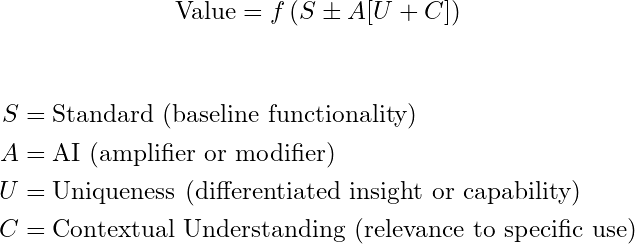
The equation for the future is "Standard fed to Unique to output Unique," emphasising the importance of uniqueness in a world dominated by AI-driven standards.