


A.I. adds to the heap of ‘same’ on the Internet by cloning and copying anything that can be described or referenced as a template online.
With minimal overhead, your winning ads, your marketing, even your products can be multiplied and replicated until your stuff is just more stuff in a wash of stuff that your customer is subjected to whenever they pick up their phone.
This makes whatever makes you unique (your USP) more valuable as a result.
I wanted to share some ways I’ve learned to look at the things that make us different, particularly in the context of business and marketing.
What’s wrong with copying something that works?
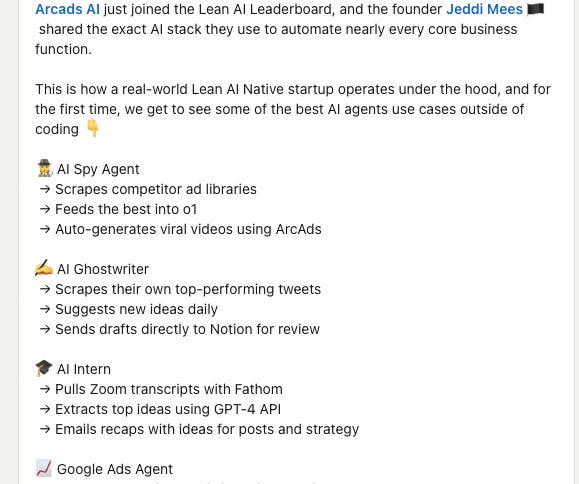
There’s a lot of value in being the same or just slightly different to your competition. Originality isn’t the only goal. Today I read about a 5 person business that reached $5M ARR by copying competitors’ ads and harvesting their marketing ideas.
This approach leverages A.I. agents for an acceptable threshold of plagiarism by getting A.I. to circumvent direct rip-offs so it’s possible to deploy working models and grab customers in any market. Pretty slick.
Copying pays, at least in the short term.
It kinda stinks.
There’s something parasitic about using the ingenuity of others to enter and win markets they worked hard to define and lock in.
Marketers can spend years looking for product market fit. One of the outputs from that hard work are the ads that attract customers successfully.
Cloning successful campaigns to hack into successful marketing funnels and divert those same audiences to your own product is a formula for success. It’s a short cut to riches, and plenty will follow this track to make money in the next couple of years.
I’m not saying there’s anything wrong with it. The best art is copied, as Bowie said (I’m paraphrasing - he’d say it with style).
The bad news for anyone copying someone else’s marketing or products is that someone else will copy you too. It’s getting very easy to do. And someone will copy that person, and so on, until your entire market is saturated with a wash of repeated archetypes that numb your customer until they turn to something new.
Not to mention - it’s boring.
The commercial benefits of leveraging the cloning and agentic abilities of A.I. to recreate something that looks like it is working for another business has a shelf life of months.
As A.I. gets better and better, the half life of anything created using an existing template gets shorter - its value decays the more there is of something to take it’s place.
Once A.I. gets a hold of a pattern that it recognises that is worth recreating, the bots will furiously spawn replicants so numerous, so quickly, you’ll be lost in the mix before you know it.
Copying can’t really form the basis of a business unless you’re constantly iterating.
You’ll spend your life looking around for the next thing to feed your copy monster in order to keep making money. Who wants to live like that?
There is another way!
Keep an eye on the target, not the prize 🎯
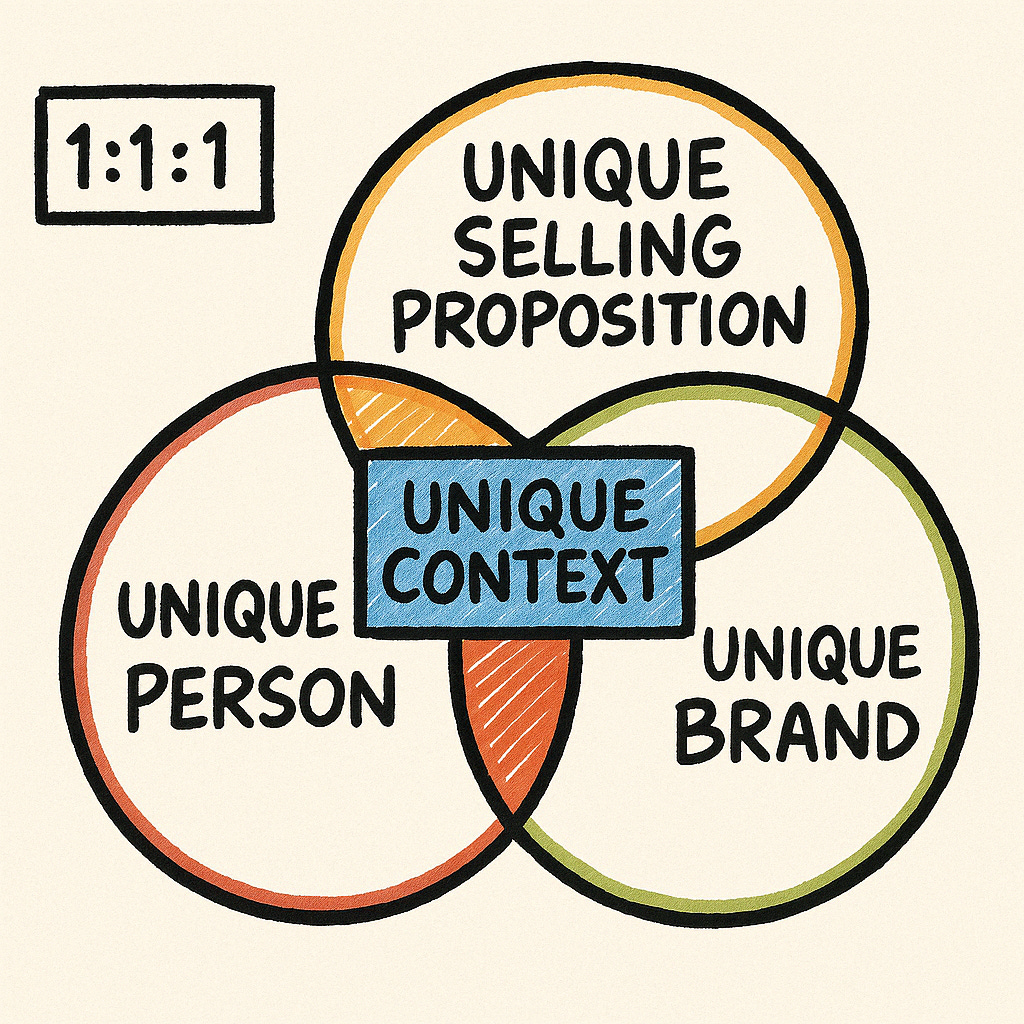
Bob Moesta's insight that "contrast creates meaning and context creates value" highlights the importance of both context and contrast in establishing uniqueness.
The good news is that if you can manage the things within your control (context and contrast) then the things outside your control (cloning and copying your USP) won’t affect your uniqueness.
You’ll remain different in a sea of same!
Uniqueness in Isolation doesn’t work
In order to compete, sometimes there’s pressure to come up with something entirely new and different.
I’m pretty sure every single CEO I’ve ever worked with has said the following two things:
Our product is completely different to everything else
Our product is in a completely new category that we now need to invent
There were a couple of exceptions, but generally in my career I gravitated towards the more innovative founders and startups who were at the cutting edge of technology.
A lot of the CEOs I worked with were scientists, engineers or mathematicians who decided to apply their amazing brains to creating products and a business around their groundbreaking ideas.
Naturally they were inclined to focus on the novel, and generally they were bored by the mundane.
Honestly, so was I. I love new things. Old things that everyone understands can be intensely uninteresting.
But repeatable, knowable systems and processes are what customers gravitate towards. And that’s what makes money.
Faced with competition that can leverage A.I. to do the same things in a fraction of the time can send founders in wild and risky directions.
Be boring where possible
A business should always try to work towards becoming boring. At least internally. It’s more profitable that way.
A.I. can help you to be more boring.
About 3 years ago, I had a gut punch realisation that my own business was going nowhere if I kept reinventing the wheel on every single project. Sure, it was entertaining, but completely unsustainable.
After 6 years of cycling through client projects of every variety and hue, I realised I was close to burn out.
I needed to take a mature look at my business to see if there was anything I could do to stand up the things that I did on a regular basis on their own, or with help, so I could sell and resell a process that didn’t cost me an arm and a leg to deliver every time.
Being boring is less fun, but healthier.
You might as well have A.I. do the bulk of the boring stuff, so you can focus on having fun.
Reinventing the wheel can feel like the only way to stand out.
The idea of being different is somewhat redundant when it’s just you and nobody else.
Take job hunting as an example.
If I was to look for a job by creating a resume that reflects the complete and exhaustive picture of what makes me unlike anyone else in the world, warts and all, I doubt I’d get an interview. It would be too risky to hire me.
Better to find a safer candidate who looks like the others, with a manageable amount of risk associated with an understandable amount of quirks.
Hiring people has always been about finding someone who meets or exceeds the standard while being aware of the risk. Ideally there’s a mutual understanding between employer and employee about areas that need development. We can work with known risks.
Employers don't expect perfection but want no surprises. They support employees in reaching standards through tools, training, or additional resources.
Uniqueness in Products
The same principles apply to products. A product reduces risk by clearly stating where it meets or doesn't meet standards. This clarity is only meaningful when contrasted with other products.
The 3 things that make you special
Comparison: Establishing a standard requires comparison with other products.
Inherent Uniqueness: Every product, even a cloned one, is unique due to variables like hosting, delivery, customer service and the different ways in which your customers will interact with your product.
Embracing Difference for Value: Being unique is about knowing about the other ways your customers could achieve the same results you offer, and showing them in contrast to your solution in order to demonstrate the value. This is crucial for job hires or product offerings.
Lessons from the elders
I recently attended the Business of Software conference in Cambridge UK.
I was surrounded by some of the world’s best coders and product developers. I listened carefully as they talked about their 20+ years in the world of software development.
The sages in the room related how they’d built and sold their companies, how they manage their teams, how they grow their business.
A lot of wisdom was concentrated into that small theatre in Churchill college, built to house innovation and new ideas.
When A.I. came up, I noticed a mixture of unease and excitement.
Vibe coding was met with a combination of awe and indignation.
“What’s going to happen when all these people who don’t know how to code simply start coding??” said most coders when they saw how easy Vibe Coding is…
Fair question.
But skipping past that existential crisis, if you’re running a business or looking for a job or figuring out how to add value in any way in order to make money, you may need to pause for a moment.
Where should you focus for the next 20 years?
The three pillars of value led by A.I.:
Standardisation: In order to survive, it seems important to quickly figure out how to repeat your best recipes over and over in the fastest, cheapest way possible so you can scale, reduce costs and remain profitable.
Own Context: In order to compete, figure out how you can leverage A.I. in a unique way to meet customers in unique situations to solve unique struggles only you can solve so the customer makes the specific progress you’re being hired to provide. Note: This is classic Jobs to Be Done theory, and it is essential.
Invent: In order to win, what new opportunities lie in wait in the untapped potential offered by limitless coding ability and an uncapped power to create new things?
How do we make money if it’s getting so easy to reproduce?
The biggest challenge to workers and businesses today is working out the commercial aspects of value in the context of A.I.
Jobs, Products, Businesses, Companies all fall into the same value bucket. They’re just systems, processes, people or things hired to help someone make progress in their lives.
Whether it’s A.I. or you fixing a problem, it doesn’t really matter. At least, if it’s a problem worth solving. A customer will choose a solution that gets the job done and I doubt many will be that fussy about the mechanism used to do it.
Commercial models depend on the notion that people will pay if you help them out. Economics are built on this idea.
A.I. can replace a lot of what jobs, products, businesses and companies did before.
The value of intelligence is plummeting.
Automation scrapes out manual work and repeated processes from any business and gives it to A.I. which can do 10x the work in a tenth of the time.
If you think this is all science fiction, here are a few stalwarts of the past 20 years that are already broken because of A.I.:
Predictable Sales: outreach and sales processes that have worked for 20 years no longer work. Ask any BDR working in any SaaS company how they’re getting meetings today.
Digital Marketing Funnels: campaigns are being stolen, replicated, used and squeezed beyond recognition until they no longer work. How’s your ad campaign doing?
Hiring: Pick a job and send your resume to a robot who reads your A.I. application to screen you for an A.I. generated list of requirements pulled from an A.I. based analysis of a pile of job descriptions until the job has nothing to do with what you actually need and the candidate is bounced at the first hurdle.
I don’t know how it’ll work in the future, but it does seem to me as though the wild variety and randomness of being human and the particulars of each individual’s taste lead to a world where standardisation, conformity and systems become less valuable than an ability to adapt to the nuances and ambiguities of helping individual people in whatever weird situations they find themselves in.
Bridging unique human conditions with empathy and understanding that only fellow humans can provide in order to use A.I. to build and manage commercial applications seems like a good place to start.
TL/DR;
Value through Contrast and Context: People seek to hire options that meet standards but are different enough to add value. This value is defined by contrast with other options and the context of the offering.
Contextual Importance: The context in which skills or tools are applied, like CRM management for example, can vary greatly depending on the situation and current state. Progress towards the future state defines the value of any contribution to a buyer’s life.
The Changing Value of Knowledge: In the knowledge work field, the value of intelligence is diminishing due to A.I. My unmatched value in areas like HubSpot implementation or revenue operations is challenged by AI's capabilities, so I now need to focus on how I can lean into empathy, creativity, experience and common sense in order to remain relevant.
AI's Impact on Expertise: A.I. can meet or exceed standards in knowledge work, reducing the value of expertise. Anyone can now be considered an expert, but what sets them apart will be how they successfully apply that expertise to solve problems and invent new things.
A Shifting Value Equation: To offer value, I must amplify my uniqueness and understand the context in which I operate.
The Equation for Value:
Application of the Value Equation:
To establish sustained commercial value, focus on what you can control (S, A, U and C) so you can deliver competitive offers, products and outputs in whatever mode you prefer (as an employee, product, business, company, artefact, ad, art piece, whatever).
This equation applies to getting work as an employee, consultant, or selling products. It emphasises value for potential purchasers and aligns with A.I. and AI Agentic work principles.
Key Idea:
Dynamic USP: My USP must adapt to the context, emphasising both uniqueness and contextual understanding.
Moving Forward
I plan to:
Communicate Uniqueness: Clearly establish and communicate what makes me unique.
Understand Context: Reflect on past projects to describe their context and where I met or didn't meet standards.
Apply the Equation: Use this equation to emphasise value in various work scenarios, whether as an employee, consultant, or in product sales.